

Time Dilation is a Mindf*ck
The twin paradox - why you age slower at lightspeed

My twin Katy and I are both 23 years old. Let’s say tomorrow, the funnier and cooler twin gets launched into space for 10 years, traveling at 99.9% the speed of light. When I return, my sister would be 23+10 = 33 years old. However, I would have only aged about 5 months.
With my recent birthday, I’d still only be 23 years old.
What?
Here’s more: let’s say Katy and I both live to 100 years old, and I spend the rest of life at 99.9% lightspeed. When Katy passes away in the year 2103, I would be a few months from turning 27.
By the time of my death in the year 3748, I would have outlived her by 1645 years.

This is not science fiction. It’s part of relativity, the field of physics fathered by Albert Einstein himself. And yes, we have extensively verified its effects both mathematically and experimentally, along with that of other phenomena.
Speed-based Time Dilation
Without taking your entire evening, here is my best attempt at explaining this:
Fundamentals to Know:
Light is made of photons - the smallest units of electromagnetic energy, which have no mass. Light has no mass.
Speed of light in a vacuum is denoted by c. c = 299,792,458 m/s. This is the fastest thing in the universe.
Objects with mass cannot reach or exceed c. Inertial resistance would require infinite energy to accelerate to this point, which is impossible.
EXAMPLE TIME!
Imagine a spaceship with a tiny “light clock” inside it. A beam of light bounces straight up and down between two mirrors. To a person inside the spaceship, the light just goes up, hits the mirror, comes back down, and marks one tick of the clock. Everything feels normal as they move with the ship.
But to someone standing on Earth watching the spaceship fly by, the light does not move straight up and down. Since the ship is also moving forward, the light appears to travel diagonally. That means, from the ground observer’s perspective, the light travels a longer path.
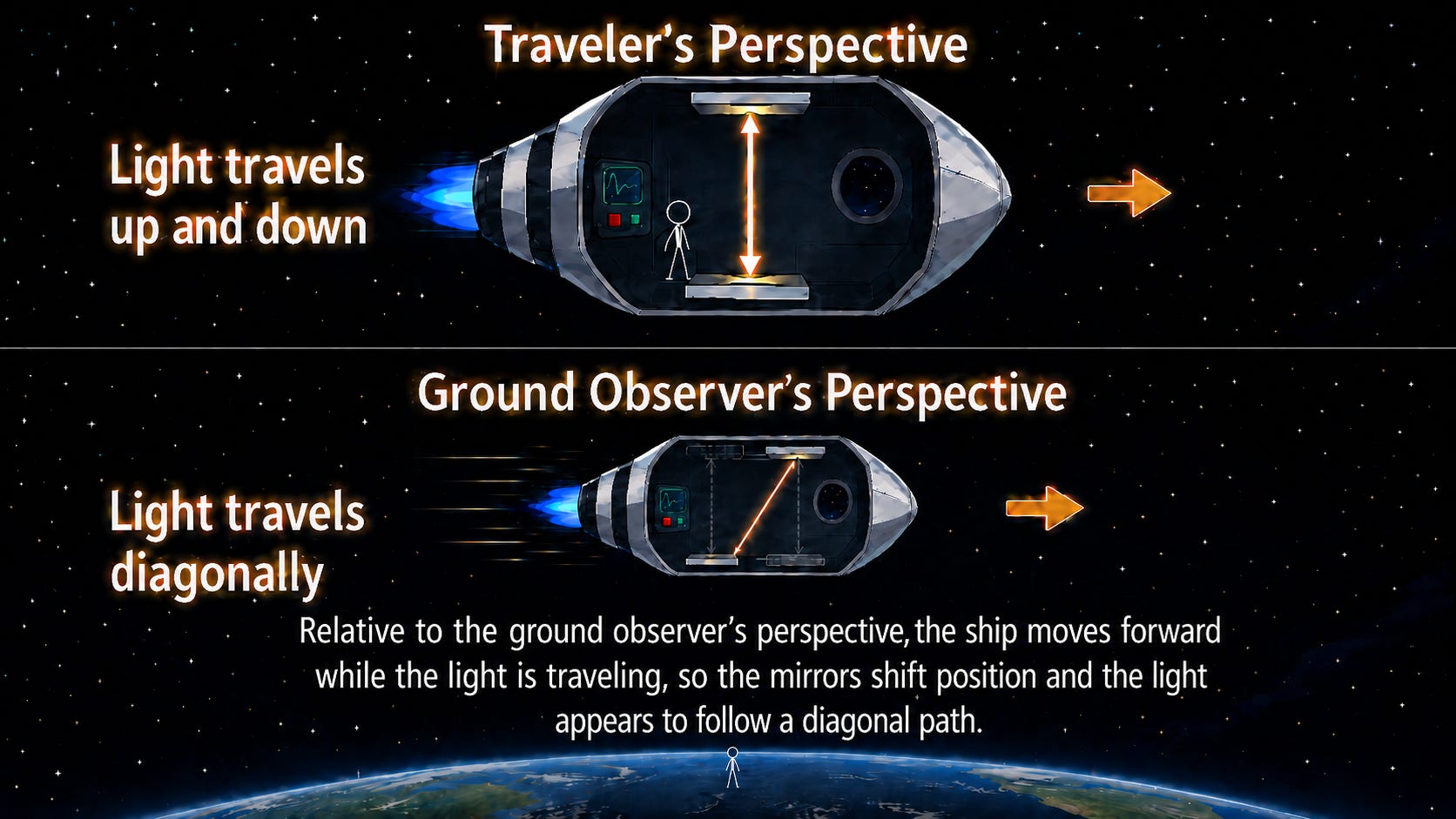
Here’s the catch: the speed of light has to stay the same for everyone.
So, if the ground observer sees the light travel a longer diagonal path, but light is still moving at the same speed, then the tick must take longer. While the traveler experiences one normal tick of the clock from the ship, more time passes for the observer on the ground. This is speed-based time dilation.
There are plenty of AI-slop reels that explain this, but I put a better video explanation I found in Sources below.
Lorentz Factor
The amount of time that’s dilated is described by the Lorentz factor.
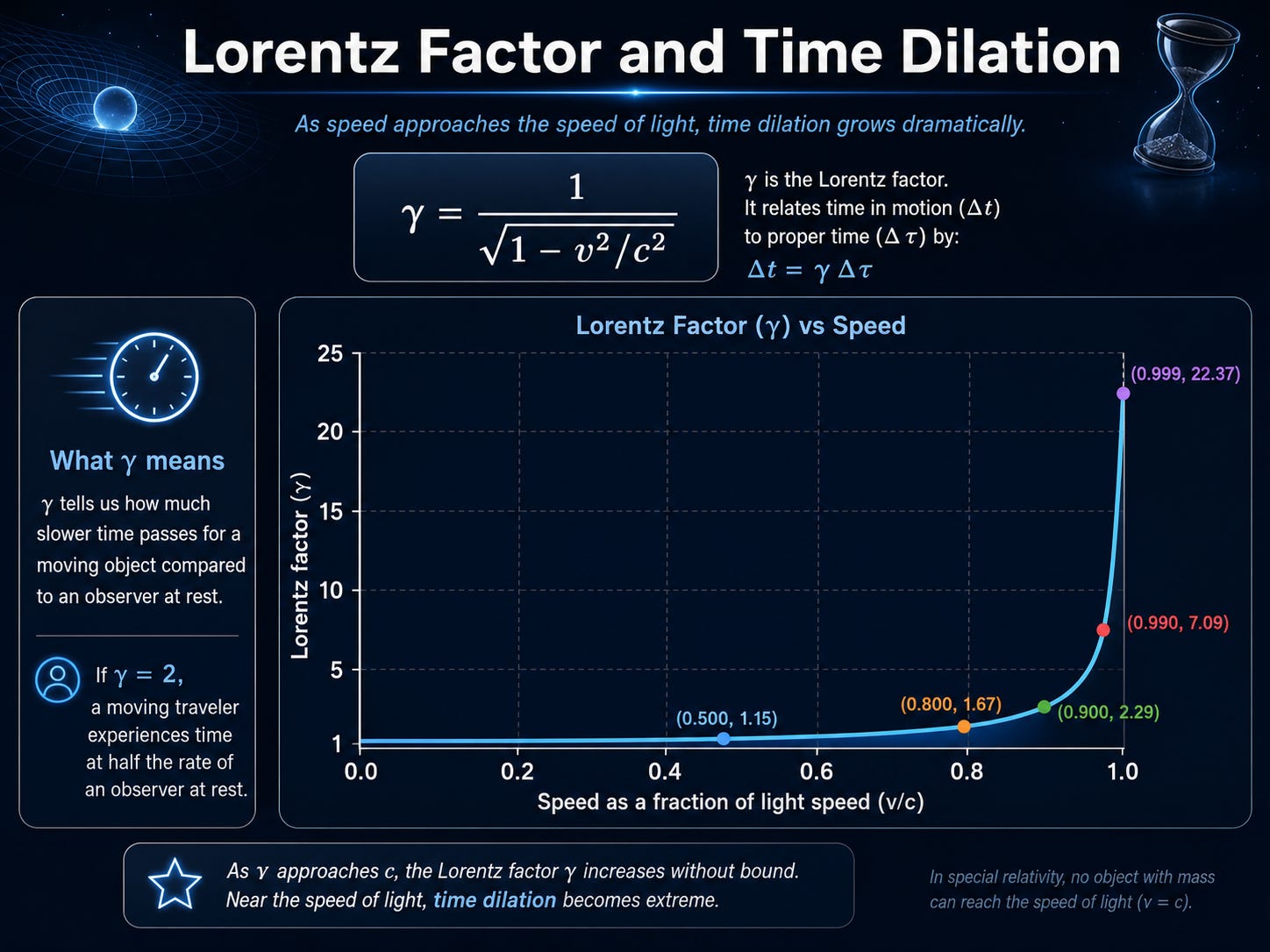
At low speeds, the curve is almost flat, meaning time dilation is tiny. This relationship is non-linear and increases dramatically when close to lightspeed c. A 10-year trip at 50% of c would still have the traveler experience about 8.66 years.
What’s Wrong and What’s Real
Admittedly, there are loopholes in the space trip example.
Anything with mass cannot travel at lightspeed, as mentioned before.
The acceleration needed to get close to c would likely kill you. Interestingly enough though, you’d be fine once you’re at terminal speed.

However, much of the hypothetical is relevant.
Astronauts on the International Space Station age about 0.005 seconds slower for every six months in space. That difference is meaningless for the human body, but it matters for systems that depend on extremely precise timing, like satellites, atomic clocks, navigation, and spaceflight.
Surprise: This .005 second is actually the result of two effects at once.
First, the ISS moves around Earth at about 7.7 kilometers per second. Because of speed-based time dilation, astronauts age slightly slower than people on the ground.
Second, the ISS is about 400 kilometers above Earth, where gravity is weaker. Because of this, their clocks tick slightly faster than clocks on Earth’s surface.
Yup, gravity dilates time too.
These two effects partially cancel each other out, with speed slowing and weaker gravity quickening time.
GPS satellites experience the same effects and tend to be much farther from Earth than the ISS. Because of this, the gravitational effect is larger. Their clocks tick faster overall unless corrected, and engineers have to account for this to prevent inaccuracies due to drift in timing.
Gravitational Time Dilation
My article on this drops Friday, 7/17. Stay tuned for it, I’ll talk about how it works and the movie Interstellar!
Thanks for reading, and if you have any feedback, I’d love to hear it!
If this post gets 10 likes, I’ll mog Katy with a 20 year lightspeed trip.

Continuing Down the Rabbit Hole…
Gravitational Time Dilation is a Mindf*ck Too (Coming Friday)
Euthanasia Coaster Ruined the Family Vacation (Coming Soon)
Gravity: The Weakest Force that Bends Space (Coming Soon)
The Missing 95% of the Universe: Dark Matter and Dark Energy
Sources Worth Checking Out:
8 Min Video: Time Dilation - Einstein's Theory Of Relativity Explained!
Article: Why Time Behaves Differently at High Speeds: Time Dilation Explained Simply Through Relativity
Article: NIST Pair of Aluminum Atomic Clocks Reveal Einstein’s Relativity…
Love Interstellar - can't wait for the next one. Love these rabbit holes :)